
Stop "Early Extension": The Simple Elbow Brace to Fix Your Receiving Mechanics
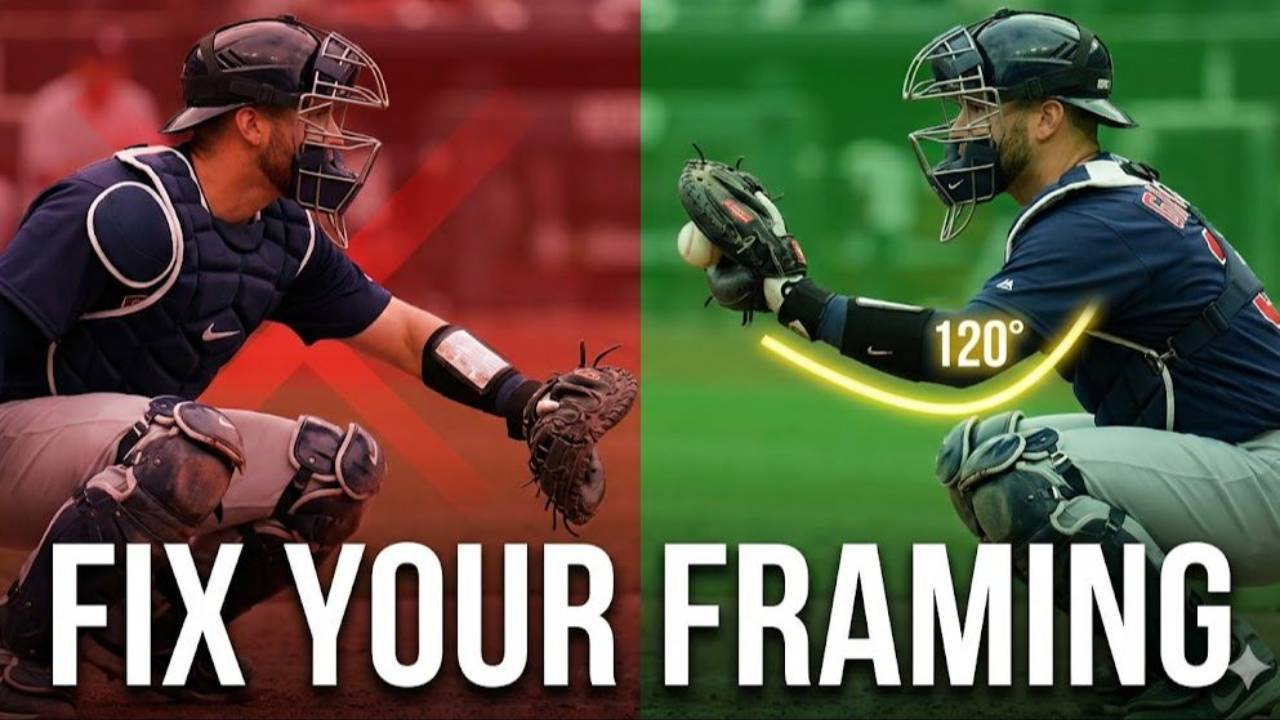
Jan 22, 2026If you are a catcher losing strikes at the bottom of the zone, the culprit is usually one specific mechanical breakdown: Early Extension.
When you straighten your arm too early while reaching for a low pitch, you lose all your leverage. A straight arm is heavy and slow; you can’t pull the ball back up into the zone effectively. Instead, the ball hits the glove, drags it down, and you lose the strike.
Today, I’m breaking down a simple tool - an adjustable elbow brace - and a specific drill sequence that forces you to stay connected, maintain strong angles, and clean up your framing.
The Setup: The 120-Degree Rule
The goal of using an elbow brace isn't to rely on it forever; it's to force your body to feel the correct position so it becomes muscle memory.
How to wear it:
-
The Angle: Lock the brace at 120 degrees.
-
Placement: Place the brace on the inside of your arm (the crease of the elbow), not down low.
Why 120 degrees? This angle keeps your lever short. When your arm is bent, you are stronger. You can drive the elbow and manipulate the baseball. If that angle opens up (extension), you lose power and the ball beats you.
The Drill Sequence
Grab your elbow brace, a heavy ball (plyo ball), a catcher's mallet, and some regular baseballs. Here is the progression to fix your receiving.
1. Mallet Scrapes (The Foundation)
Start with your mallet and the heavy ball. Get into your stance with your shoulders over your knees.
-
The Goal: Keep the face of the mallet working back toward the pitcher or angled slightly for the specific pitch shape (e.g., angling for a lefty slider).
-
The Movement: Work on "scraping" or picking the low pitch.
-
The Brace’s Job: If you try to reach out and extend, the brace will physically stop you. It forces you to use your body and shoulder to get to the spot, rather than cheating with your arm.
2. Short Hops (Heavy Ball)
Move to receiving short hops. Focus on keeping your glove vertical.
A common mistake here is "flaring" the pocket out to the side. Don't do that. Keep the pocket on the plane of the pitch. Because you are wearing the brace, you have to trust your eyes and your body positioning to get behind the ball, rather than stabbing at it.
3. Understanding Body Flow (Proximal to Distal)
To receive high-velocity pitching, your kinematic sequence needs to be correct. Movement should flow from Proximal (center of body) to Distal (extremities).
-
Shoulder moves first.
-
Elbow drives next.
-
Wrist finishes the move.
Pro Tip for Inside Pitches: You must pre-set your body. If you are catching a two-seam fastball running inside, you need to get your shoulder and elbow around the ball before it arrives so the pocket can actually "see" the baseball.
4. Full Speed Translation
A drill is useless if it doesn't transfer to the game. Once you feel comfortable with the heavy ball, take the heavy ball away but keep the brace on.
Have a partner throw regular baseballs at full speed. Focus on applying force through the baseball. You should feel the difference immediately - the brace won't let you get "long," so you’ll feel snappier and stronger in the zone.
Bonus: The Walkout Drill (Footwork)
While we are fixing mechanics, we can't ignore footwork on pitches that are out of reach.
If a ball beats you too far to your glove side, you need to use the Walkout Technique:
-
Start from a one-knee-down stance.
-
Reach for the ball.
-
Use your blocking technique or step across to gain distance.
Final Thoughts
The elbow brace is a feedback tool. It tells you instantly when you are getting anxious and extending too early. Use it during your warm-ups or bullpen sessions to groove that 120-degree angle, and watch your strike percentage on low pitches go up.
Want to drop your pop?
A bad pop time will:
-Have teams run on you
-Make you sit on the bench
-Get you crossed off coach's list
Grab this free 15-minute video to understand the three phases of a throwdown and learn how to drop your pop.
You'll also get helpful catching tips in your inbox. Don't worry, we won't send spam. Unsubscribe at any time.

